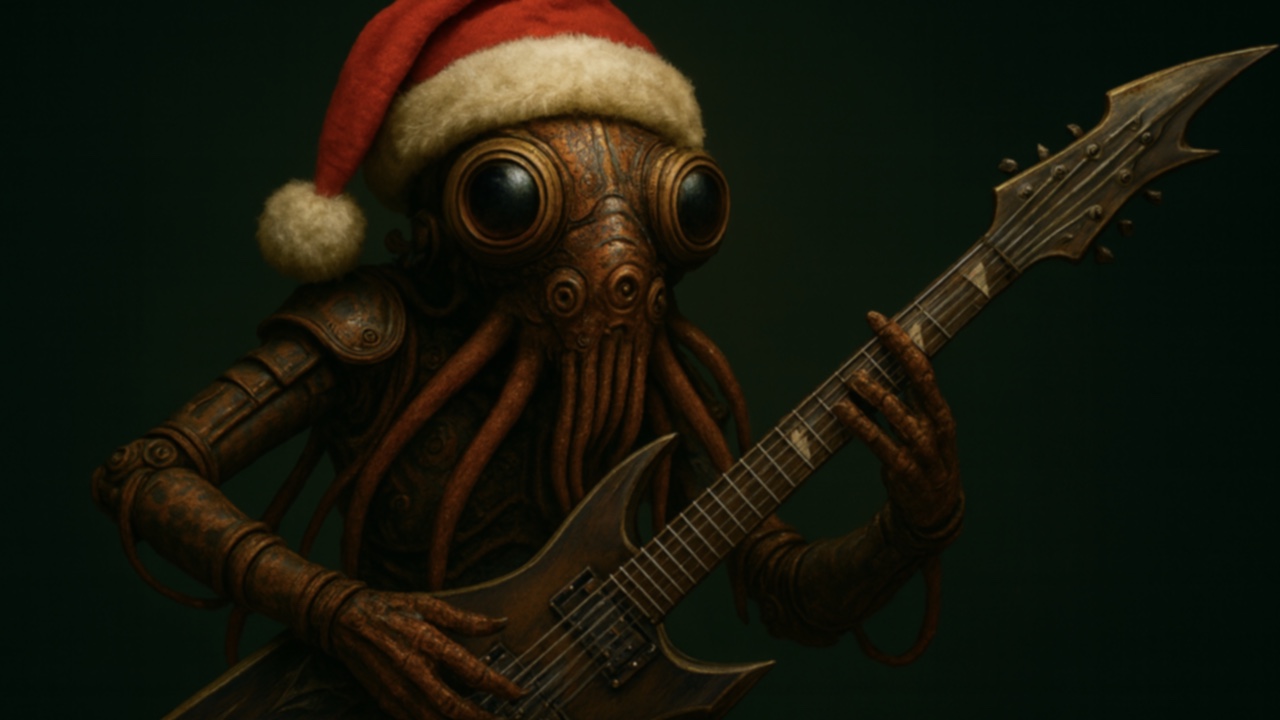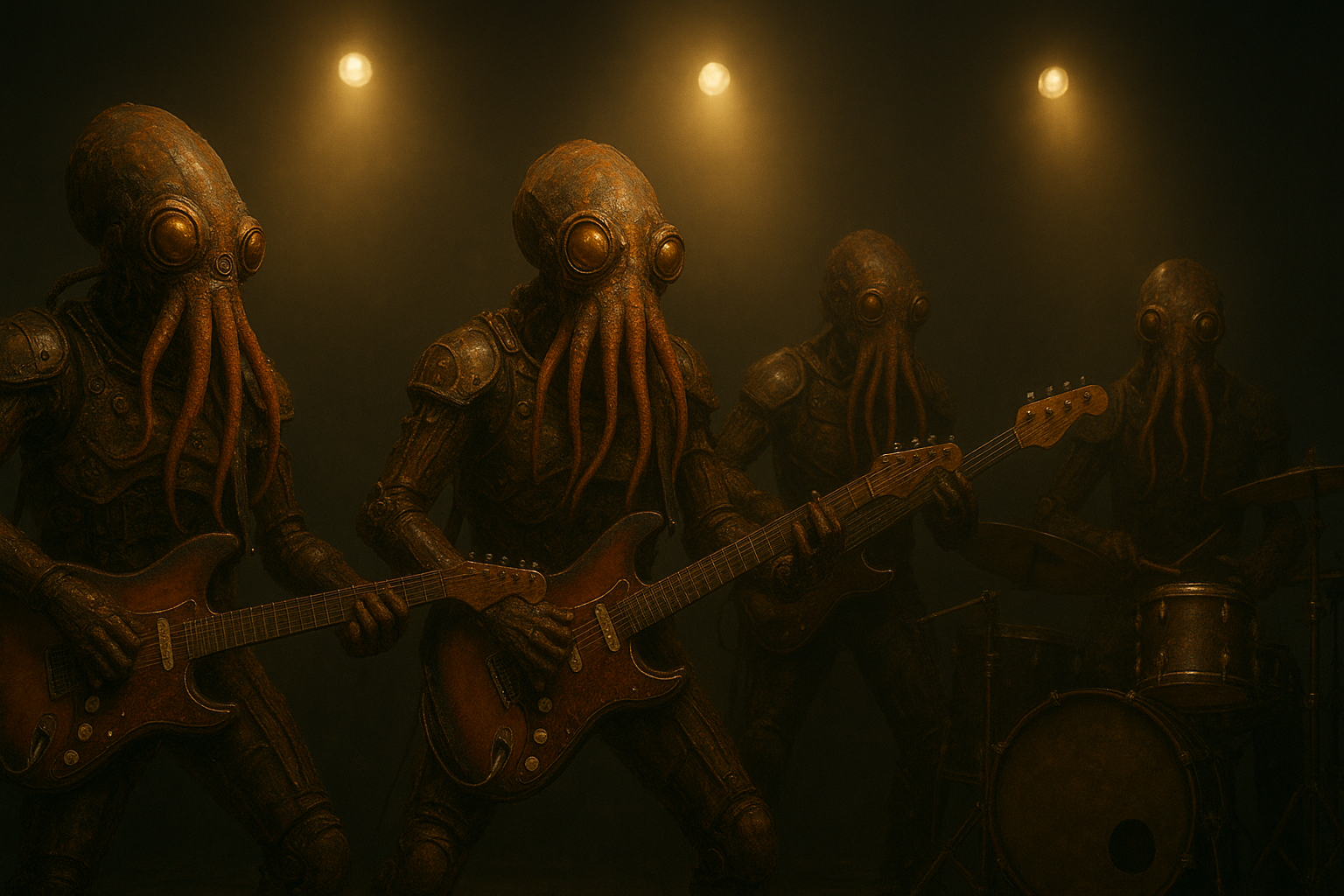

The Cephalobörgs: Origins
If you don't fully understand something, don't worry: communication is only possible where understanding finds its limits.
— Humboldt Mantlepiece, guitarist and cephalopoet
Timelines
In one of the temporal lines, the Cephaloborgs appeared after a worldwide catastrophe. The Caribbean Crisis deviated slightly from the history textbooks. A shoe striking a podium, combined with a series of coincidences, led to humanity's extinction as a species and the emergence of new ones, including the Cephaloborgs. They evolved from crustaceans and mollusks in the radioactive ocean, adapting everything that remained of human civilization—from fans and wires to great ships and broken mechanisms. They became cyborgs not because they wanted to, but because there was no other way. They built their cities, their technoculture. From time to time they can be seen on deserted beaches*, where they gaze at the starry sky, dance, and reflect on the structure and meaning of "all this stuff."
*The Cephalobörgs reflected on the events of this timeline in 'The String Theory' — a song with an animated music video. See: The String Theory.
But in another temporal line, humanity did not perish. On the contrary—by a certain point, humans no longer needed planets in the usual sense. Their cities existed in orbital structures, their bodies in transitional forms, their memory in distributed media. People left Earth easily, so as not to interfere with those who would come next in their place. And they came. Not from radioactive ruins, but according to the nature of Earth itself, again and again reproducing more or less intelligent forms of life.
Inkwell Sinkwell and The Third Timeline

And in the third line, there were neither humans nor octopuses in any usual sense. There were consciousnesses without definite form as we understand it, consciousnesses smeared across space and time, manifesting as scattered coincidences and resonances. Take, for example, Inkwell Sinkwell, the group's guitarist. If one compiles and analyzes the texts of his songs and interviews, one can come to the conclusion that he is a rhythmic gust of wind at three o'clock in the afternoon. But he is also the splash of water in some nameless river, and the autumn rustle of sugar maple leaves. You might object: how can this be? Wind is wind, and a splash is a splash, and between them lie kilometers, hours, or even centuries—no connection at all. But the connection nevertheless exists, though human consciousness experiences certain difficulties when trying to focus simultaneously on such unfamiliar objects. It is especially difficult to see behind them an Other, possessing not only consciousness but also a sense of humor, not to mention a musical ear. Nevertheless, such focusing is possible, and we should say a few words about it.
It occurs through one of the cyborgs' discovery of the so-called Orthogonal Key of Nonlinear Ontologies. The Cephalopedia Britannica devotes several sections to this device, describing its operating principles in detail, and we refer interested readers to that resource for technical specifics. For our purposes, it's enough to know that it runs on two AA batteries, is built into the Cephaloborgs' metal exoskeletons, and acts like a lens, focusing different temporal lines at the point of "now" and making communication possible with a consciousness fundamentally different from our own—in a form accessible to most of our readers.